
Jev is not an LLM. Here's why that matters for trading decisions
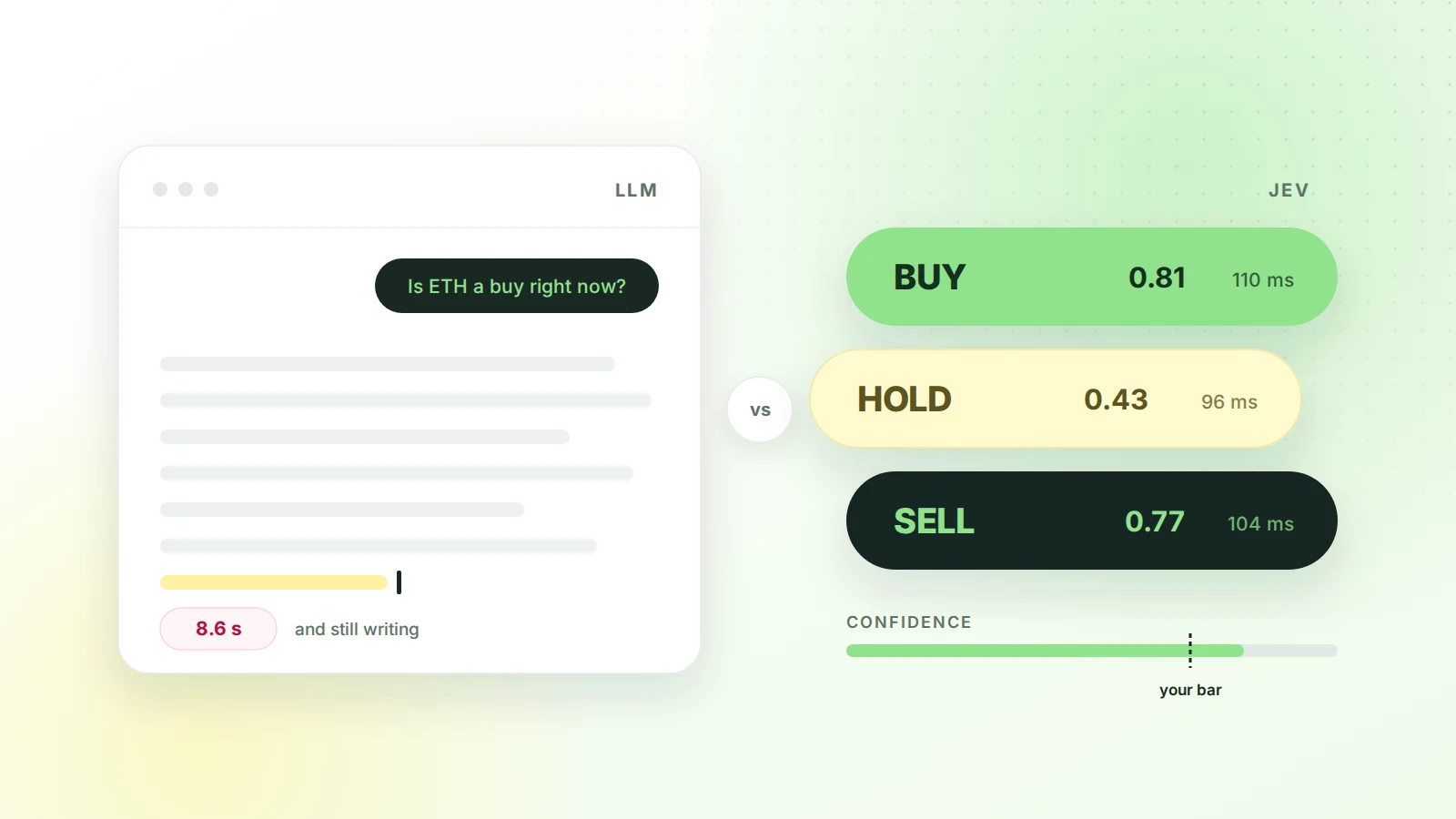
On September 15, a San Francisco lab called TypeSafe AI released a model that can't write a sentence. It can only decide: buy, hold or sell, yes or no, one to five, each with a probability attached, in about a tenth of a second. Within days, developers had wired it to live markets. Here's what Jev is, how it differs from the LLMs you already know, and the honest version of what it can and can't do for a trader.
What Jev actually is
TypeSafe AI came out of two years in stealth with what it calls a System One model. The name comes from Daniel Kahneman's Thinking, Fast and Slow: System 1 is the fast, intuitive part of the mind, System 2 the slow, deliberate part. Today's chat models, with their long chains of reasoning, are System 2 machines. Jev is built to be the other half.
The company was founded by Diogo Almeida, a former OpenAI researcher who worked on the methods that taught language models to follow instructions. His framing question is a good one: models have been excellent at chat for years, so where is all the automation? TypeSafe's answer is that chat models were trained to please human readers, not to be called by software millions of times a day. So it built a different stack: a new architecture, a parallel sampler, and a training method it calls Reinforcement Learning for Calibrated Decisions.
In practice, you send Jev two things: a state (the context, as text) and a set of questions. There are only three kinds of question:
| Question type | What it returns | A trading-shaped example |
|---|---|---|
| Choice | One option from your list, plus a probability for every option | Buy, hold or sell? |
| Score | A position on a scale you define | How stretched is this move, 1 to 5? |
| Noul | A yes/no, as a probability from 0 to 1 | Is momentum weakening? |
That's the whole interface. Jev can only ever return one of the options you gave it, so it cannot invent a ticker, a price or a fourth answer. TypeSafe's slogan for this is "decisions, not strings".
How that differs from an LLM
A language model generates text one token at a time, each token conditioned on the one before it. That's why a thoughtful answer takes seconds, and why longer answers cost more. Jev has no text to generate. It evaluates every question in the request in parallel and returns the results together. One developer measured a batch of 13 questions in a single call as about 10 times faster and 12 times cheaper than asking them one after another.
| LLM | Jev | |
|---|---|---|
| Output | Free text (or JSON it was asked to write) | A typed value from options you defined |
| How it answers | Token by token, in sequence | All questions in one parallel pass |
| Typical response time | Seconds, sometimes minutes with reasoning | 70 to 500 ms, per TypeSafe |
| Price | Dollars per million tokens, output costs extra | $0.042 per million input tokens, output free |
| Confidence | Only what it says in words | A probability for every option, every time |
| Can it explain itself? | Yes | No. It returns the decision, never the reasoning |
| Can it make things up? | Yes, fluently | It can't invent an option, but it can pick the wrong one |
The speed and cost claims, with the fine print
These are TypeSafe's own figures, from benchmarks it built itself, and the company says openly that they sit "on the higher end of real world gains". Early independent tests point the same direction with smaller multiples. A test by the newsletter Every, as reported by Forkast, found Jev roughly 25 times faster and several hundred times cheaper than a frontier model on its task, while catching six of seven planted defects where the frontier model caught all seven.
That last detail is the important one. Jev is not smarter than a frontier LLM, and TypeSafe doesn't claim it is. On the company's own chart, Jev scores 67.8%, level with mid-tier LLMs at around 68%, while the best large models reach 73 to 74%. And that score measures agreement with the answers of two frontier models, not agreement with ground truth. The pitch is not better judgment. It's comparable judgment at a speed and price that change what you can build.
The number that matters most: confidence
Ask a chat model how sure it is and it will tell you, in words, whatever sounds reasonable. Those words are a poor guide to whether it's right. Jev was trained specifically so its probabilities mean something: answers it gives 90% should be right about 90% of the time.
One independent developer put that to a pre-registered test across roughly 9,750 calls. When Jev reported 0.9 confidence or higher, it was correct 92% of the time. Calibration was best on yes/no questions and noticeably weaker on rating scales, so it isn't uniform. But the conclusion was memorable: you can get the same answer out of any LLM, you cannot get the same number.
For a trader this is the interesting part. "BUY" on its own is noise. "BUY at 0.81" and "BUY at 0.52" are two different pieces of information, and a system can be told to ignore the second one entirely.
Why this matters for trading decisions
Markets move faster than paragraphs. A considered LLM answer takes several seconds to arrive. That's fine for research and useless inside a fast loop. Within a week of launch, developers had published open-source demos that ask Jev for a decision on a loop: one is built around Monad's roughly 300 ms blocks, another runs a one-second tick across five markets on Hyperliquid. Whatever you think of trading that fast, it's a design that isn't possible with a model that needs eight seconds to finish a sentence.
Typed output is safer to automate. When software acts on prose, it has to interpret it, and "cautiously bullish, though a pullback is possible" can be read three ways. A value that can only be buy, hold or sell cannot be misread.
Cheap decisions can be asked again. At a small fraction of a cent per decision, you stop rationing questions. You can re-ask every few seconds, ask several independent questions at once, and watch how the confidence drifts as conditions change.
Discipline becomes a setting. A confidence bar is a rule you set once, calmly, and the system applies without emotion at 3 a.m. That's the same virtue old rule-based bots had, with a model that can read context instead of a single price trigger.
Here's roughly what one request looks like:
// state: plain text describing the market right now
state: "ETH/USDC, 15-minute chart. RSI(14) is 71, which is overbought.
        Price is above its 50-period average. Funding is positive and rising.
        Volume on the last three candles is falling."

// questions: typed, answered in parallel
action    (choice)  buy | hold | sell
weakening (noul)    "Is upward momentum weakening?"
stretched (score)   1 = not at all … 5 = extremely

// response
action:    hold   { buy 0.15, hold 0.62, sell 0.23 }   confidence 0.43
weakening: 0.78
stretched: 3.9
Illustrative and simplified, not the exact API or a real market reading.
Notice the state says "RSI is 71, which is overbought". That isn't decoration. It points at the most important limitation in this whole article.
What Jev can't do
It can't do arithmetic. Developers who've tested it report that Jev cannot reliably count, compare two numbers, or reason about dates, which it reads as plain text. Trading is made of numbers. So every indicator, level and percentage has to be computed by ordinary code first and handed to Jev already interpreted. Code calculates, Jev judges.
It can't explain. There is no reasoning to read, only the decision and its probabilities. If you want to know why, you need a different model.
It can't say "I don't know". It always returns one of your options. Uncertainty shows up only as low confidence, which is exactly why a confidence gate isn't optional.
It can be confidently wrong. A typed answer is guaranteed to be valid, never guaranteed to be correct. TypeSafe itself calls its "zero hallucinations" figure a property of the schema, not an empirical accuracy result. Independent tests so far are mixed: Jev beat larger models on one real task and lost on another.
Fast is not the same as profitable. None of the public trading demos publish results, and nothing about speed makes a decision right. Markets are harder than sorting support tickets. A model that decides 75 times in the time an LLM decides once can also be wrong 75 times.
Think slow, act fast
The pattern emerging across the industry is to use both kinds of model, each for what it's good at. LangChain, which shipped a Jev integration within two days of launch, uses it to route requests and to check an agent's risky actions before they run, and is blunt that it "isn't a drop-in replacement for an LLM". Another write-up put it well: the question is no longer only which model, but which type of model, a generator, a reasoner, or a decider.
Read that diagram from a trader's seat. The numbers come from code, because neither kind of model should be trusted with arithmetic. The understanding comes from an LLM agent with live data, because that's the part that can weigh a news event against your risk profile and tell you why. The split-second call comes from a decision model, because it's the only one fast enough and the only one that reports a usable confidence. And the final word belongs to limits that you set and that no model can override.
What we're doing with it
elvaro today is the top row of that diagram: an agent that researches every source, knows your profile, and delivers signals with an exit plan, while you decide and you execute. That stays the default.
We're now building the bottom row as an opt-in: Jev trading, onchain on Base. You fund a wallet, set your limits, and Jev trades supported assets inside them. The design rule is the one from this article: elvaro thinks, Jev acts, and your rules sit in between. A hard maximum per trade. A confidence bar below which a decision becomes a hold. A pause that stops new trades immediately.
We won't tell you it's more accurate than a frontier model, because the evidence says it's about level. We won't show you return figures, because there aren't any worth trusting yet. What we can say is that it's the first model we've seen that is fast, cheap and honest enough about its own uncertainty to sit inside a trading loop with a human's limits wrapped around it.
You set the limits. Jev trades inside them. Jev trading is in development. Join the waitlist, or try the elvaro agent that's live today.
Join the waitlist →Sources and further reading
- TypeSafe AI | Introducing System One Models & Jev (Sep 15, 2026)
- TypeSafe AI docs | Confidence
- LangChain | What Is Jev? A Guide to TypeSafe AI's System One Model (Sep 17, 2026)
- Flavio Copes | A deep dive into Jev, TypeSafe's System One model
- Primeline | TypeSafe Jev vs Claude Code: 4 Models, 2 Real Jobs (pre-registered test)
- Langfuse | Using TypeSafe's Jev for evals (Sep 18, 2026)
- Forkast | TypeSafe AI's Jev Is Not an LLM, And That May Be the Point (Sep 17, 2026)
- DataCamp | Jev: TypeSafe's System One Model
- Beam AI | Jev by TypeSafe: A Decision Model for AI Agents (Sep 18, 2026)
- GitHub | jarrodwatts/jev-trader and aowang-ai/jev-trade (open-source demos)
- elvaro blog | AI trading bots vs. chatbots vs. agents
Speed, cost and accuracy figures are reported by TypeSafe AI or by the independent authors cited, and have not been verified by elvaro. Jev and TypeSafe are names of TypeSafe AI; elvaro is not affiliated with TypeSafe AI. elvaro provides research and analysis, not financial advice. Automated trading can lose money quickly. Crypto assets are volatile; you can lose what you invest. NFA / DYOR.
More from the blog

AI trading bots vs. chatbots vs. agents: what's actually different
Three very different technologies get sold under one label. How each works and where each fails.
Read →
Coinbase and Robinhood just validated the AI trading copilot
What the two biggest retail platforms got right, and the one thing an exchange-owned copilot can't offer.
Read →